
The Road from Naturalism
Six books that changed my worldview

If the “bitter lesson” in artificial intelligence is that general methods trump specific ones, I think the bitter lesson for human intelligence is the opposite: specific, historically situated, interpretive understanding trumps what we generally think of as “critical thinking” skills.
Over the last five years a handful of books have shifted the way I try to make sense of the world in this direction. This can be loosely labeled as a move away from “naturalism” — an orientation towards understanding and analysing the world in the mode of the natural sciences — which is the default intellectual culture that I think most of us are inducted into.
What I’ve moved towards is harder to label, but is broadly more “humanistic” and has something to do with taking history, meaning, and tradition more seriously than my previous frame allowed.
This is an attempt to chart out my journey so far, through the books that had a particular impact on me.
2020: Alvin Plantinga and Epistemology

As a now 30-year old in the UK, I grew up in the decade of New Atheism, where debates about God and religion seemed to take up a huge chunk of online discourse, and as a Muslim, I’d had many conversations with friends about God over the years.
On the recommendation of a friend, I read Alvin Plantinga’s Knowledge and Christian Belief. This was my first exposure to academic philosophy and it was a mind-expanding experience.
In this book, Plantinga separates the charge that theistic belief is false from the charge that it is somehow or other intellectually deficient, e.g. irrational, separately from its truth or falsity. The book focuses on this second type of claim.
Plantinga first tries to identify the specific objection in this type of claim — what are we getting at when we criticise a belief as “irrational”? He suggests that we might be thinking about justification: that the belief is irrational because it isn’t sufficiently justified. And the standard we might have in mind is that we should be able to justify our beliefs with some kind of deductive argument ultimately tracing back to undeniable or self-evident propositions. This view is broadly known as “classical foundationalism”.
This was essentially the pre-articulate picture of knowledge that I had in my head: of course our beliefs should follow from propositions which can be traced back to solid starting premises that we can all agree on!
Plantinga then points out the problem: this kind of foundationalism doesn’t itself follow deductively from indubitable premises in this way. It doesn’t meet its own standard of justification; it’s self-defeating.
I hadn’t seen this kind of argument before and reading it for the first time was mind-blowing. It seemed so obvious after-the-fact, but I hadn’t managed to spot it for myself.
This was exciting but also worrying: not only had I unknowingly taken this foundationalist picture of knowledge for granted, but I also hadn’t figured out what was wrong with it.
What else had I been taking for granted, and what else was I missing?
2021: Alasdair MacIntyre and History
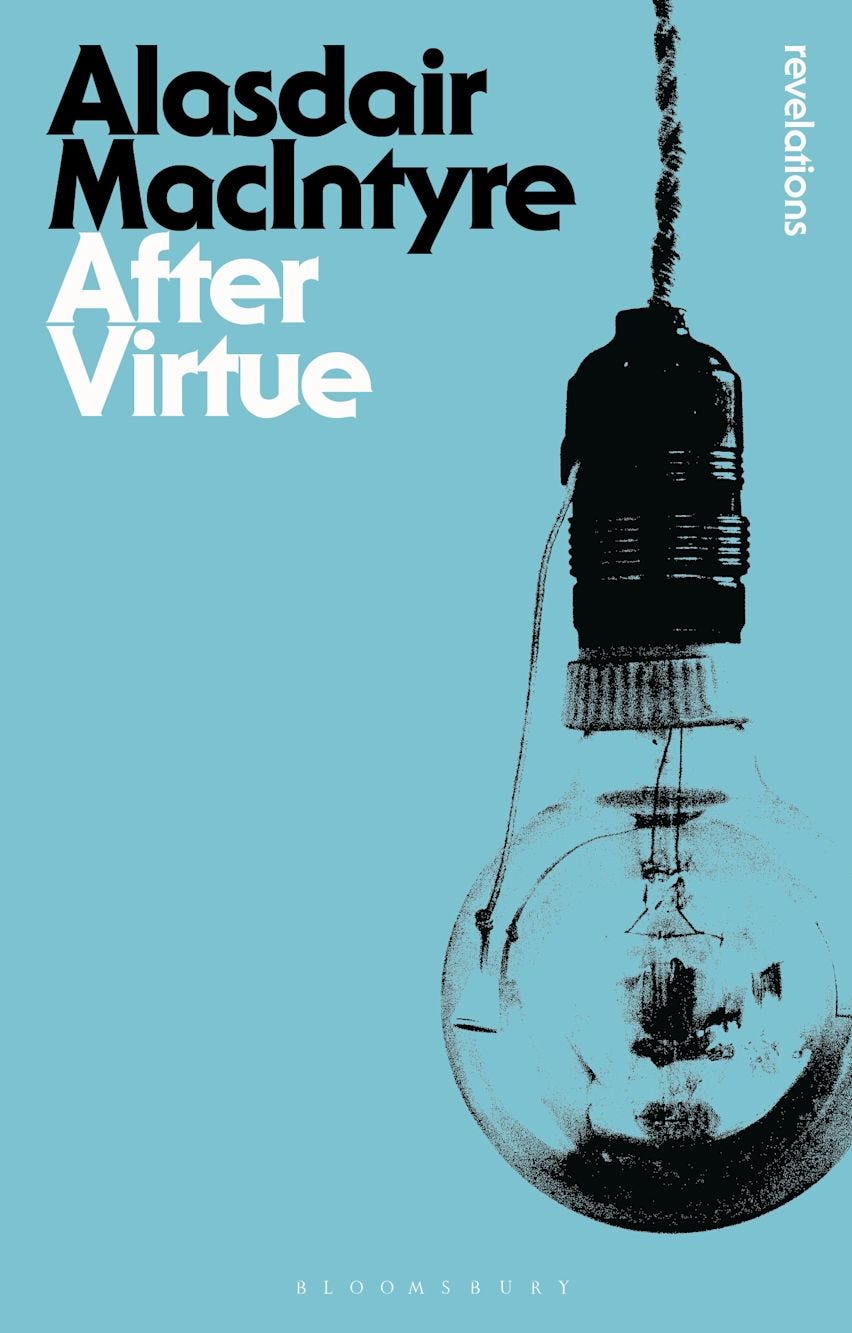
A friend recommended After Virtue to me in 2019 but my reading age wasn’t high enough at the time — there were very long sentences with big words that I just couldn’t parse fast enough to fluently read.
In 2021 I took another stab. This was a bit more fruitful, but I had to give up after very slowly getting through the first couple of chapters, to try again in the future.
Despite this, struggling through those first few chapters was illuminating, and I knew it would be worthwhile to wrap my head around this book at some point.
MacIntyre opens After Virtue with a thought experiment:
Imagine that the world goes through a political revolt in which the scientific enterprise is destroyed — labs are burned, scientists are executed, and science is abolished in schools and universities. All that’s left are fragments of books and equipment, and eventually, a group of people try to pick up these pieces — they memorise the book fragments and tinker with equipment, thinking they’re doing science again. But they would not in fact be doing science, and they’d have no way of recognising this, even with the tools of modern philosophy at their disposal.
He then offers his “disquieting suggestion”:
The hypothesis which I wish to advance is that in the actual world which we inhabit the language of morality is in the same state of grave disorder as the language of natural science in the imaginary world which I described. What we possess, if this view is true, are the fragments of a conceptual scheme, parts which now lack those contexts from which their significance derived. (Alasdair Macintyre, After Virtue, 1984)
According to MacIntyre, the moral vocabulary we use today (”ought”, “duty”, “obligation”, etc.) originated and made sense within a specific kind of worldview in the past. In the modern West, he contends, we discarded this worldview but still attempt to use its language, and this leads to problems and confusion.
Aside from the obvious, MacIntyre’s suggestion was disquieting for me for another reason: that I’d never considered the history and origins of important concepts, and I generally operated as if our present terms and categories for understanding the world were woven into the fabric of reality and could be simply applied across time and place.
The early chapters of After Virtue still only planted the seed of this historicism in my mind, and it would be a little while before it fully took root.
MacIntyre proposes that a symptom of our confused situation is that modern moral debate is interminable: arguments based on “rights” are pitted against those based on “utility”, “justice” is invoked against “survival”, and so on, but these premises are incommensurable and we become stuck in “unargued disagreement”:
From our rival conclusions we can argue back to our rival premises; but when we do arrive at our premises argument ceases and the invocation of one premise against another becomes a matter of pure assertion and counter-assertion.
Yet if we possess no unassailable criteria, no set of compelling reasons by means of which we may convince our opponents, it follows that in the process of making up our own minds we can have made no appeal to such criteria or such reasons. If I lack any good reasons to invoke against you, it must seem that I lack any good reasons. Hence it seems that underlying my own position there must be some non-rational decision to adopt that position. (Alasdair Macintyre, After Virtue, 1984)
This is a problem for all of us — if our reasons ultimately rest on premises which are contested by others but for which we can’t give further justification, how rationally did we adopt those premises?
Like Plantinga’s earlier argument, this felt similarly groundbreaking — it was a shocking observation, and not one that had ever crossed my mind.
I would pick After Virtue back up once or twice a year, but it wouldn’t be until 2024 that I’d manage to read it properly and finally finish it.
2022: Charles Taylor and Human Nature
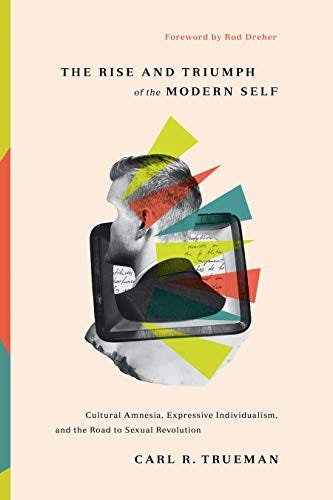
I can’t remember where I came across The Rise and Triumph of the Modern Self (RTMS), but it was probably on Twitter. It opened my eyes to the panoply of distinctly modern ideas about personal identity that were embedded so deep in me that I was unaware of them. The book thoroughly finished what After Virtue had started in getting me “history-pilled”.
The Rise and Triumph of the Modern Self traces a genealogy of our conception of selfhood — what it is to be human — starting with an illustrative question: why is the sentence “I am a man trapped in a woman’s body” intelligible to me but would not have been to my grandparents?
One of the themes that the book unpacks is the modern ideal of authenticity: that each of us has “inner depths” where our “true self” resides, and that flourishing requires expressing this inner truth and having it affirmed by others. In this moral vision, psychological well-being is the highest good, and “being true to ourselves” becomes the path to get there. To support this, society’s function shifts from a civilising role — pushing us to transcend ourselves — to a therapeutic role — helping us feel comfortable “in” ourselves. Sexuality comes to lie at the heart of this authentic self, while paradoxically, sex itself becomes disenchanted and stripped of moral significance.
I’d previously taken most of this for granted as common sense, so it was illuminating to explore how these ideas came to feel so intuitive. The story is long and runs through many thinkers and movements, but the overarching shift is from a world that was understood to be inherently ordered to a world where each of us must make our own order. In the pre-modern view, our identity was given to us by this order — we looked outward to God, tradition, and community to know our place in the world and how to live well. In the modern view, our identity comes from within — the world has no order except what we project onto it, we must each discover and choose our own way to live well, and the satisfaction of individual preferences becomes our yardstick.
Exploring this intellectual history made our modern ideas about identity visible to me for the first time, and helped me see where they might be misguided and what other options there might be on the table.
The book also kicked off a major shift in the way I try to understand and explain the world:
When attempting to explain human behaviour, we naturally make a ‘nature vs nurture’ distinction: we try to separate the culturally contingent from the universally human. The issue is that our ideas about human nature often begin where our cultural fluency ends — most of us are barely articulate about our own culture, let alone others’, so we should expect a big gap between where our cultural understanding runs out and where universal human nature begins. Armchair social commentary tends to ignore this.
Another thing I was surprised to find out was how few important thinkers there are in most fields at any point in time, and how few books actually make original contributions versus synthesise existing ideas for a new audience. RTMS is in this ‘synthesis’ bucket, drawing from Charles Taylor, Philip Rieff, and Alasdair MacIntyre, and putting their ideas into a more readable (but still very long!) package for a popular audience.
One effect of this is that I’m now much more wary about jumping into a new book. I’ll usually do some research to see what the big ideas/thinkers are in a field, then see whether people recommend reading their primary texts vs summaries vs derivative works. For better or worse, this usually ends with me reading a bunch of Reddit threads and Goodreads reviews and then moving on without reading the book.
2023: Physics and Metaphysics
I previously held the folk conception of science as being a specific method that can give us rock-solid knowledge about the world. More than that, I had bought into the idea that humanity was on a steady march to bringing all knowledge under the realm of science, and that for any given field of enquiry, it was only a matter of time before science would come to explain it.
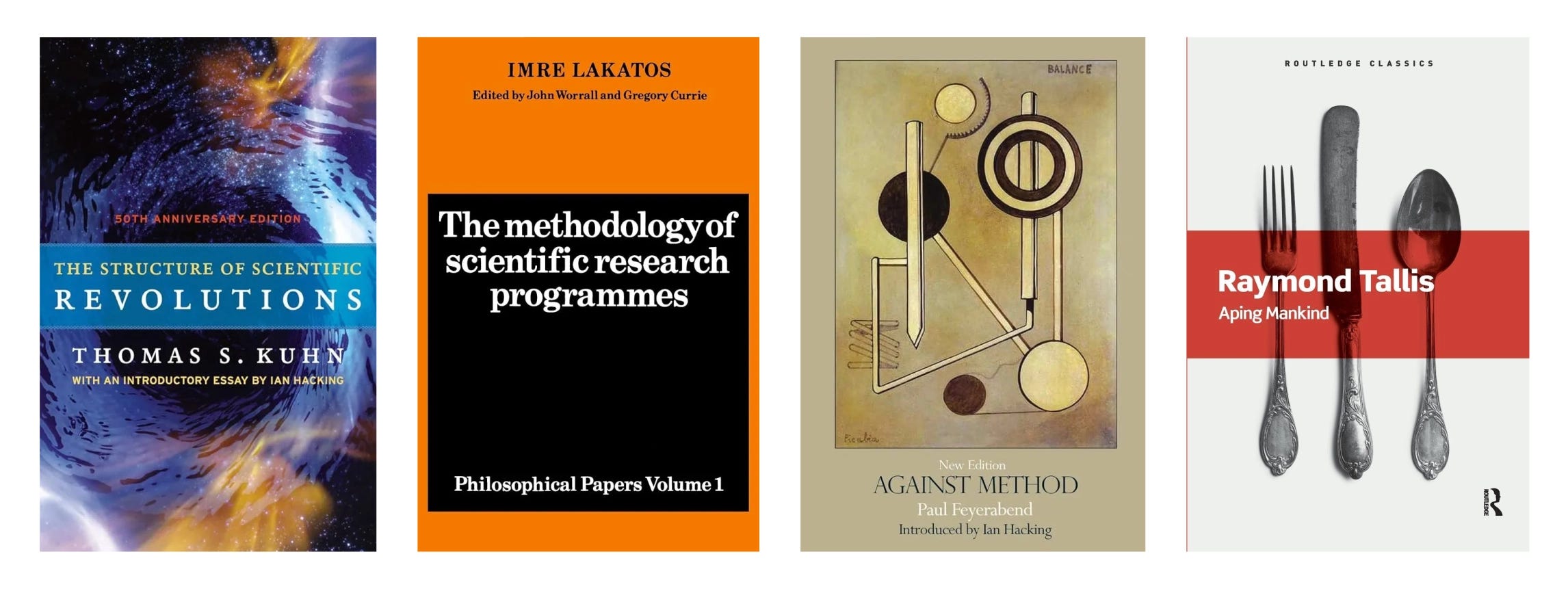
Reading some history and philosophy of science shattered this view: Thomas Kuhn’s The Structure of Scientific Revolutions, Lakatos’ Methodology of Scientific Research Programmes, and Feyerabend’s Against Method.
The main transformative idea was that science isn’t simply a cumulative process of attaining knowledge by making observations to test theories, but rather that scientific knowledge always exists within a “paradigm”: a framework of assumptions and standards that a particular scientific community assumes as their starting point. These assumptions aren’t easy to justify solely by the data, and if we look at how science undergoes “paradigm-shifts”, new ideas that are later taken for granted are often vehemently resisted when first proposed. Many competing theories can “explain” the same data so science can’t be seen as a purely empirical pursuit, and what’s more, it’s hard to even make a purely empirical observation — observations come “theory-laden”.
None of this has a bearing on the practical applications of scientific discoveries, but where it did have a big impact was in “re-enchanting” the world for me. Whereas previously my picture of the cosmos was a kind of “billiards table” of determined matter to which everything reduced, I had now started to see the world as much more mysterious and marvellous, and gained an awareness that everything is still very much “up for grabs”. It’s hard to point to any outward actions this has driven in my life, but my subjective experience of the world feels somehow more “open” and rich, and this all has renewed the fascinated interest I had in science as a kid. That mainstream science education is what dulled this interest and closed my world is a real shame.
Going down the science rabbit hole makes it hard to avoid metaphysics: the big questions about the ultimate nature of things. I had long assumed that the “billiard table” model of reality was simply the modern scientific position — that everything that exists must be made of the same “stuff” that physicists study. In particular, this view entails that our first-person conscious experience “emerges from” electrical impulses in our brain, which I’d also accepted without much thought.
I came to learn that this reductive materialist picture wasn’t demanded of me by any “scientific worldview” as such, and that modern physics, if anything, makes “matter” seem a lot stranger than old ideas about immaterial minds or souls. What I found especially interesting was that academic philosophers are pretty divided on these questions, whereas my uninformed perception was that this was a settled issue.
Alongside this physical reductionism about the cosmos, Aping Mankind by Raymond Tallis opened my eyes to a related phenomenon: scientific reductionism about the human person. The author takes aim at two prevalent attitudes, which he labels “Neuromania” — the belief that we are our brains — and “Darwinitis” — the belief that evolution not only explains the origin of human beings but also explains our fundamental nature.
You would have to be remarkably resistant to brainwashing to resist the claim–endlessly repeated–that we are our brains. The notion that our consciousness, the self to which the successive moments of consciousness are attributed, our personality, our character, personhood itself, are identical with activity in our brains is so widely received that it seems downright eccentric to profess otherwise. (Raymond Tallis, Aping Mankind, 2021)
In the book, Raymond Tallis suggests that our uncritical acceptance of Neuromania and Darwinitis is the result of post-Enlightenment secularisation: religion placed Man in a special place in the cosmos, and in our reaction against this we now seek to “put humanity in its place” and “emphasise that we are, above all, animals”. But Tallis, himself an atheist, urges against throwing the baby out with the bathwater: “we are best understood as human beings rather than smart chimps”.
The book calls out examples of neuro-evolutionary reductionism in everyday life, such as popular articles claiming to have discovered the “neural basis” of things like love, aesthetics, morality, accompanied with pictures of brain scans purporting to explain these phenomena. Tallis highlights the limitations of fMRI data and poor study design in these popular experiments, but most of all, emphasizes the conceptual errors involved in identifying neural activity with conscious experience.
Just as lightning doesn’t explain electrical discharges in the air, brain activity can’t be said to explain our subjective conscious experience without first importing a host of metaphysical assumptions.
2023: Jason Blakely and The Hermeneutic Turn
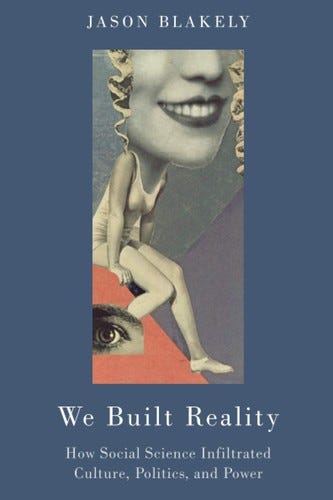
When I was still struggling through After Virtue, I stumbled across Jason Blakely and We Built Reality.
The book looks at how seemingly objective observations in the social sciences don’t simply describe the world, but actually go on to shape it in highly subjective ways:
Over the course of this book I argue that this long-standing distinction between description and prescription, fact and value, is far more complex and porous than this venerable dogma (traceable to the great empirical philosopher David Hume) would have one believe. (Jason Blakely, We Built Reality, 2020)
Jason takes aim at our culture of ‘scientism’ — giving undue authority to scientific methods — and shows how our reverence for the natural sciences has led us astray when it comes to analysing and interpreting social reality. He highlights economics as the ‘queen’ of the social sciences, closest to the metal of supposed hard facts, and used as the guiding tool for the most important decisions taken by our most important institutions — “it’s the economy, stupid!”.
The authority of social science, we are told, comes from its practical utility — social scientists are trained to uncover the hidden laws of how people and systems behave, which have a predictive power that helps us shape outcomes in the real world.
The big problem with this is that social scientists have a really bad track record at predicting the big things that matter most: economists consistently fail to predict recessions, political scientists failed to predict the fall of the Soviet Union or the Arab Spring. At smaller scales, government policies rooted in economic models have a mixed record at best, and often turn out to achieve the opposite of what they intended.
The other problem is more implicit: in imagining economics as a “science of human behaviour”, and treating economists as rational, scientific authority, we may unknowingly start to think about ourselves in economic terms. And this has indeed happened — the metaphor of economics has come to dominate the way we talk and think about ourselves.
It was recently popular to claim that humans are simply self-interested agents trying to maximally satisfy their individual preferences. All our beliefs and goals could be transcribed into this logic: financiers and soup kitchen workers are both ultimately selfish, with the latter just happening to prefer the feeling they get from helping others. The 2000s spawned a genre of “popular economics” books encouraging this mode of thought:
Freakonomics presented these conclusions in the dispassionate, objective voice of science. Realtors who consistently fetched worse deals for their clients than for themselves were in no way egoistic, greedy, lacking empathy, or otherwise shirking their moral obligation to their clients. “The point here is not that real estate agents are bad people,” they wrote, “but simply that they are people—and people inevitably respond to incentives”.
Indeed, a follower of the Freakonomics sensation in the early 2000s would have learned that calculating in terms of rational self-gain at the cost of others was simply the scientific thing to do. (Jason Blakely, We Built Reality, 2020)
The “everyone is just selfish” framing of ‘rational choice theory’ has become less fashionable, but we’re already living it:
What emerged was an extended metaphor of society as an individualistic market. Society itself was simply a relationship between producers and consumers… In fact, cheating the common good simply made one rational and clever (not paying taxes made one “smart”). After all, there was no public good once the assumptions of a decision science were in place. Rather, the whole point of society was to acquire the best “deal” possible for oneself personally. (Jason Blakely, We Built Reality, 2020)
While there may be good civic reasons to avoid tax, we must be honest — this isn’t why we do it. We are no longer committed citizens in a democracy, but detached consumers in a market.
It was interesting to learn that the intellectual forefathers of modern economics never thought that negotiated self-interest was enough to sustain society — John Locke and Adam Smith both believed that we needed to cultivate sentiments of sympathy and care towards fellow citizens. Modern academic economists also tend to be conservative about their work, understanding their models to be simplifications that might sometimes yield insights in narrow technical domains. Yet, Jason writes, “this was not the form of economics that had triumphed in the popular imagination.”
I’m embarrassed to admit that I had fully drunk the Homo Economicus kool-aid from my late-teens through university and into my early-20s. Looking back, it appealed to me because it felt somehow objective and scientific, and was a simple framework that could seemingly be used to explain almost everything, while also making me feel smart.
While economics today tries to LARP the natural sciences, this wasn’t always the case:
Two centuries earlier economics had been a form of thinking inseparable from philosophy and history. The greatest economists of that earlier age had also been historians and political philosophers. But beginning in the twentieth century a new discipline of thought emerged that heavily stressed seemingly timeless formal models and mathematical sophistication. The historians, philosophers, and humanists were gradually kicked out of the respectable branches of the profession. (Jason Blakely, We Built Reality, 2020)
It’s possible to read We Built Reality and conclude that this is all just a “skill issue” — that economists just need to account for more variables so that their models become more predictive, and that we the public just need to be more discerning to avoid overextending economic concepts. But the real point of We Built Reality is deeper and went over my head the first time I read it.
It took me a bit of time and wider reading around these topics to grasp this properly, but Jason’s real point is that we need to fundamentally rethink how we attempt to explain human affairs.
To explain a phenomenon in the natural sciences is to identify a general “law” which it obeys: the apple falls from the tree because of “the law of gravity”, gas expands when heated because of the “ideal gas law”, and so on.
Naturalistic social science tries to do the same — we make some observations about human behaviour, and then try to derive some general laws that produced them: “birth rates fall because of rising education and higher income”. This approach can be a fair description of a phenomenon, and it may sometimes be able to predict, but it doesn’t explain.
The alternative to this is a “hermeneutic” approach that takes seriously the fact that human action is constituted by meaning. The intention behind an action is central to what it is, so to adequately explain human actions, we can’t just look at outward appearances (”empirical data”) even if they sometimes make accurate predictions.
This interpretive approach also recognises that we can’t actually say anything non-trivial about social reality from a neutral standpoint — our descriptive language is irreducibly evaluative, and value judgments are baked into our choices of what to even study or measure. This is subtle, but has made me go from interpreting social science as giving an “objective” understanding of reality, to instead creating a particular kind of world.
The main effect of this for me has been to filter out overly naturalistic attempts at explaining people and societies, which accounts for the vast majority of what comes up online (X, podcasts, Substacks, etc).
In the natural sciences, parsimony is seen as a virtue. The reasons are partly pragmatic (it’s easier to work with simple theories and it reduces the risk of overfitting on noise) and partly metaphysical (we believe that the universe is fundamentally elegant and that the laws that govern it will be few, beautiful, and unified), and these have been vindicated by our empirical success in being able to describe a huge range of phenomena with a few simple equations.
When it comes to social explanation, though, I think the opposite heuristic applies. Because human action is driven by intentions and meanings which are historically and culturally contingent, we shouldn’t a priori expect tidy explanations. The default unit of analysis should be very small in order to get close to the fundamentally hermeneutic “ground truth”, and only then can we occasionally find broad patterns that fit tidy explanations. These should be earned and grounded in reality, rather than floating on clouds of abstractions.
Why do I think that the “hermeneutical turn” is very important? Because in its absence, social and political theorists are tempted to deal in dummy universals, processes in different societies grouped together under a single name, which are in fact very different, because even if the agents concerned use the same vocabulary, or terms which are held to be translations of each other, the actual self-understandings can be widely different from culture to culture, and the generalizations we make can only take fright at the price of a lot of fudging. (Charles Taylor, The Explanation of Behaviour, 1964)
2024: After Virtue Revisited
In 2024 I picked up After Virtue again, and could finally read it properly.
After identifying the problem of our incoherent moral discourse, MacIntyre explains how we ended up in this situation:
During the Enlightenment (17th–18th century Europe), ideas around freedom, scientific rationality, and religious tolerance led to an intellectual movement that sought to provide a basis for morality without reference to God. Morality, for the first time, had become “the name for that particular sphere in which rules of conduct were neither theological nor legal nor aesthetic”.
It was interesting that while the justification of morality was in flux, its content was generally understood to already be clear:
Kant never doubted for a moment that the maxims which he had learnt from his own virtuous parents were those which had to be vindicated by a rational test. (Alasdair MacIntyre, After Virtue, 1981)
Kant was in this sense conservative. He agreed with and wanted to preserve the morality of his milieu, including opposition to sex outside of marriage and homosexuality. But if Kant thought that the moral norms of 18th century Königsberg made sense under his theory, then what does this mean for the modern Kantian who thinks the moral norms of 21st century London also make sense under the same theory? What accounts for the gap?
Though this isn’t MacIntyre’s focus, this question reinforced the hermeneutic lesson for me. Modern disagreements often fixate on methodology, with each side acting as if their position simply pops out of their chosen and correct decision-making procedure (e.g. following a principle of equality, or maximising wellbeing). The real site of important disagreements is not at the surface level of procedure, but is much “thicker” and requires an interpretive understanding of the background beliefs and meanings that people inhabit.
Another anecdote from the book really stuck with me for the same reason, in which MacIntyre recalls Captain Cook’s voyage to the Polynesian islands at the turn of the 18th century, from which we get our word taboo:
Cook and his seamen were surprised that at the same time as having shockingly lax sexual habits, the islanders had strict prohibitions on other aspects of male-female interaction, such as men and women eating together. When asked why men and women couldn’t eat together, the Polynesians replied that this practice was taboo. But when the English visitors enquired further, they couldn’t get any more information about taboo — the explanation stopped there. 40 years later, King Kamehameha II became notable for breaking this system of taboo, and he was able to do so with ease.
Clearly taboo didn’t just mean “prohibited” since it was given as a reason behind specific prohibitions. So what did it mean, and why was it so easily abolished? Could the Polynesians have come to use a word that they themselves didn’t really understand?
Anthropologists suggest that taboo rules start off embedded in a context in which they make sense, but eventually the context shifts from beneath them and we become no longer able to articulate what they mean or why we should keep them:
Mary Douglas has argued that the taboo rules of Deuteronomy presuppose a cosmology and a taxonomy of a certain kind. Deprive the taboo rules of their original context and they at once are apt to appear as a set of arbitrary prohibitions, as indeed they characteristically do appear when the initial context is lost, when those background beliefs in the light of which the taboo rules had originally been understood have not only been abandoned but forgotten. (Alasdair MacIntyre, After Virtue, 1981)
MacIntyre points out that if the Polynesians had “enjoyed the blessings of analytical philosophy”, then they could have put forward exactly the same arguments to explain taboo that have been put forward by modern philosophers to explain the words good, obligatory, and right. We know, however, that their taboo is not an autonomous field of study to be explained in a vacuum, but an inheritance from a previous cultural background to be explained with reference to this history, so, MacIntyre asks, “Why should we think about our modern uses of good, right, and obligatory in any different way from that in which we think about late eighteenth-century Polynesian uses of taboo?”.
A common feature of our modern discourse is to look at an aspect of a culture in the past or present, and on failing to make sense of it from our own cultural standpoint, dismiss it as the simple product of irrationality or prejudice. Taking the case study of the Polynesians on board, a much better angle would be to focus on the broader framework in which that particular aspect would have been intelligible, and cautiously proceed from there, keeping in mind that our language encodes the categories through which we make sense of the world, which will be radically different than those of our subjects, and therefore that important facets of different cultures will be literally unthinkable to us without serious conceptual scaffolding first being set up. This is not to fall into relativism — we can criticise other cultures but if we want to be able to explain or understand them, then we need to be more sophisticated.
So, what’s the broader framework in which MacIntyre thinks our moral vocabulary once made sense? It is one in which Man has a determinate purpose, or telos. In this scheme, humans begin imperfect and seek to achieve a perfected condition. Moral rules are what bring about this transformation, and moral concepts like “good” and “ought” were defined in relation to this telos. In this teleological framework, to ask “is he a good person?” is much like asking “is this a good stopwatch?”.
The modern framework has two of these pieces but is missing the third: we still recognise our imperfect condition and we still have the moral rules, but we no longer have a specific end toward which the rules move us — we must obey moral rules for the sake of morality itself. A “good person” is no longer like a “good stopwatch”.
This is the framework on which the dominant strands of modern moral and political philosophy rest, which attempt to bracket substantive views of what humans are for and instead try to find the right set of abstract rules from which we can derive how we should live.
But does this work? I don’t think so. Even when we try to reason in this standpoint-neutral way, our arguments end up smuggling in our background assumptions about human flourishing and the good life — these are doing the real work, whether we acknowledge them or not. We haven’t escaped teleology.
Given this, we should stop seeking a naturalistic objectivity and aspiring to a “view from nowhere” when trying to make sense of the world. Instead, a better place to start is right where we inescapably find ourselves. We always already inhabit rich frameworks of meaning, with normative ideas about what’s worth wanting and what kind of life is worth living. Only by becoming articulate about these can we understand ourselves, and from there start to meaningfully make sense of others and the world.
Conclusion
“Critical thinking” is often treated as an abstract toolkit — ‘logical fallacies’, ‘cognitive biases’, ‘Bayes theorem’, ‘occams razor’, ‘evolutionary psychology’, ‘incentives’ — to be applied to brute facts in order to make sense of things.
This kind of approach tends to treat our present categories as universal rather than contingent, ignore the background frameworks that drive our analyses, and explain other people’s behaviour in terms that they themselves would find unrecognisable.
I'm now skeptical of social explanations that, modelled on physics, pursue law-like generalisations as ends in themselves. A lot of online social commentary — on declining birth rates, the mental health crisis, secularisation and religious revival, and so on — sadly falls into this pattern. These are important topics that deserve proper analysis.
Predictive correlations can sometimes be useful, but only as a means to reaching the real, hermeneutic understanding from which we can start to solve problems.
But crucially, I don’t think the purpose of a more humanistic orientation is to create more effective technocrats. Rather, it is to support a worldview that can make real sense of ourselves and the world, and fruitfully develop through our encounters with reality.